Signals and Systems
Fourier Transform
Practice questions from Fourier Transform.
11
Total0
Attempted0
Correct0
IncorrectConsider a continuous-time, real-valued signal whose Fourier transform exists.


Which one of the following statements is always TRUE?




Sign in to see the solution
Log in to view the explanation, track your attempts, and keep your progress.
Sign in to UnlockConsider two continuous time signals x(t) and y(t) as shown below
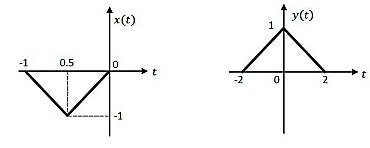
If X(f) denotes the Fourier transform of x(t), then the Fourier transform of y(t) is__________.




Sign in to see the solution
Log in to view the explanation, track your attempts, and keep your progress.
Sign in to UnlockThe relationship between any N-length sequence x[n] and its corresponding N-point discrete Fourier transform X[k] is defined as

Another sequence y[n] is formed as below

For the sequence x[n]={1,2,1,3}, the value of Y[0] is __________
Sign in to see the solution
Log in to view the explanation, track your attempts, and keep your progress.
Sign in to UnlockLet be a strictly band-limited signal M bandwidth B and energy E. Assuming the energy in the signal is






E
2E
Sign in to see the solution
Log in to view the explanation, track your attempts, and keep your progress.
Sign in to UnlockThe Fourier transform of is


Note:





Sign in to see the solution
Log in to view the explanation, track your attempts, and keep your progress.
Sign in to UnlockIn the table shown below, match the signal type with its spectral characteristics.
Signal Type
(i) Continuous, aperiodic
(ii) Continuous, periodic
(iii) Discrete, aperiodic
(iv) Discrete, periodic
Spectral Characteristics
(a) Continuous, aperiodic
(b) Continuous, periodic
(c) Discrete, aperiodic
(d) Discrete, periodic
(i) (a), (ii) (b), (iii) (c), (iv) (d)

(i) (a), (ii) (c), (iii) (b), (iv) (d)
(i) (d), (ii) (b), (iii) (c), (iv) (a)
(i) (a), (ii) (c), (iii) (d), (iv) (b)
Sign in to see the solution
Log in to view the explanation, track your attempts, and keep your progress.
Sign in to UnlockLet an input having discrete time Fourier transform.

be passed through an LTI system. The frequency response of the LTI system is . The output of the system is







Sign in to see the solution
Log in to view the explanation, track your attempts, and keep your progress.
Sign in to UnlockLet be passed through an LTI system having impulse response . The output of the system is






Sign in to see the solution
Log in to view the explanation, track your attempts, and keep your progress.
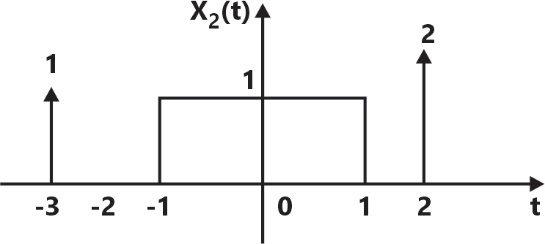
Sign in to UnlockLet and is shown in the figure below. For , the is _________. (rounded off to the nearest integer).




Sign in to see the solution
Log in to view the explanation, track your attempts, and keep your progress.
Sign in to UnlockLet be a white Gaussian noise with power spectral density . If is input to an LTI system with impulse response . The average power of the system output is __________ W. (Rounded off to two decimal place).



Sign in to see the solution
Log in to view the explanation, track your attempts, and keep your progress.
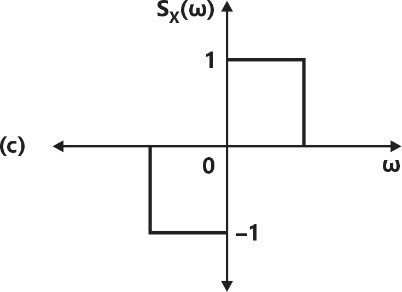
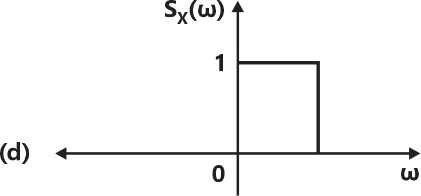
Sign in to UnlockFor a real signal, which of the following is/are valid power spectral density/densities?


Sign in to see the solution
Log in to view the explanation, track your attempts, and keep your progress.
Sign in to Unlock