Signals and Systems
LTI Systems
Practice questions from LTI Systems.
42
Total0
Attempted0
Correct0
IncorrectConsider a discrete-time linear time-invariant (LTI) system , where


Let
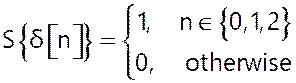
where is the discrete-time unit impulse function. For an input signal , the output is






Sign in to see the solution
Log in to view the explanation, track your attempts, and keep your progress.
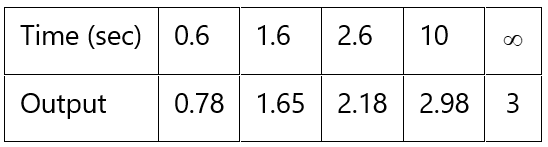
Sign in to UnlockSelected data points of the step response of a stable first-order linear time-invariant (LTI) system are given below. The closest value of the time-constant, in sec, of the system is
Sign in to see the solution
Log in to view the explanation, track your attempts, and keep your progress.
Sign in to UnlockLet continuous-time signals and be



Consider the convolution . Then is


Sign in to see the solution
Log in to view the explanation, track your attempts, and keep your progress.
Sign in to UnlockThe continuous-time unit impulse signal is applied as an input to a continuous-time linear time-invariant system . The output is observed to be the continuous-time unit step signal . Which one of the following statements is true?


Every bounded input signal applied to results in a bounded output signal.
It is possible to find a bounded input signal which when applied to results in an unbounded output signal.
On applying any input signal to , the output signal is always bounded.
On applying any input signal to the output signal is always unbounded.
Sign in to see the solution
Log in to view the explanation, track your attempts, and keep your progress.
Sign in to UnlockSuppose signal is obtained by the time-reversal of signal , i.e., . Which one of the following options is always true for the convolution of and ?



Sign in to see the solution
Log in to view the explanation, track your attempts, and keep your progress.
Sign in to UnlockWhich of the following statement(s) is/are true?
If an LTI system is causal, it is stable.
A discrete time LTI system is causal if and only if its response to a step input is 0 for .


If a discrete time system has an impulse response of finite duration the system is stable.


If the impulse response for all , then the LTI system is stable.


Sign in to see the solution
Log in to view the explanation, track your attempts, and keep your progress.
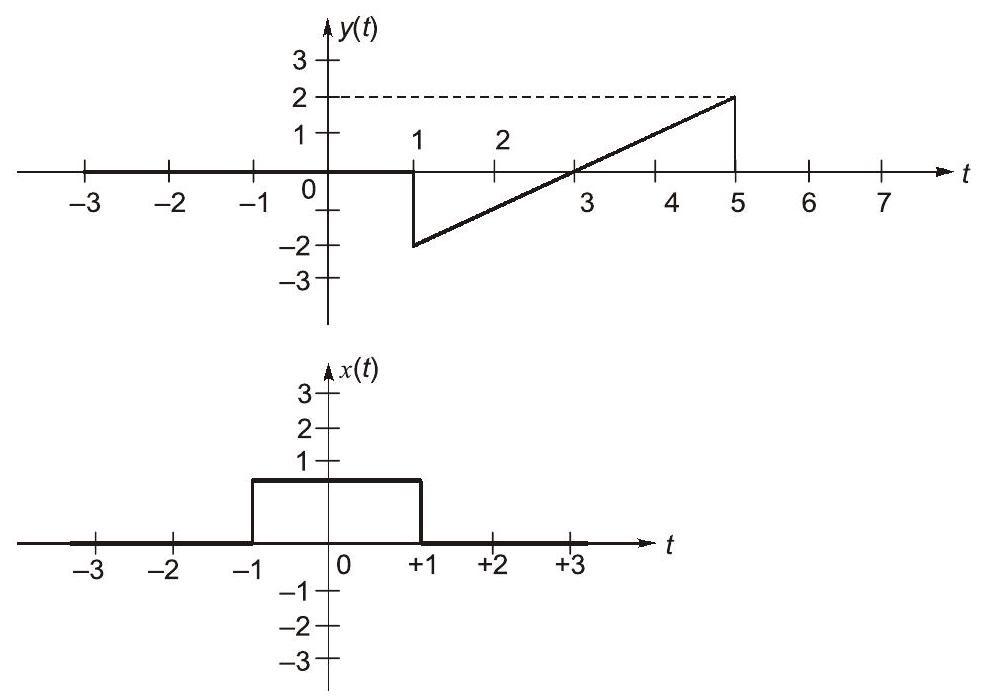
Sign in to UnlockFor the signals shown in the figure, is maximum at . Then in seconds is __________ (Round off to the nearest integer).




Sign in to see the solution
Log in to view the explanation, track your attempts, and keep your progress.
Sign in to UnlockLet a causal LTI system be governed by the following differential equation , where x(t) and y(t) are the input and output respectively. Its impulse response is


Sign in to see the solution
Log in to view the explanation, track your attempts, and keep your progress.
Sign in to UnlockConsider the system as shown below

where . The system is

Sign in to see the solution
Log in to view the explanation, track your attempts, and keep your progress.
Sign in to UnlockIf the input x(t) and output y(t) of a system are related as y(t) = max (0, x(t)), then the system is
Sign in to see the solution
Log in to view the explanation, track your attempts, and keep your progress.
Sign in to UnlockTwo discrete-time linear time-invariant systems with impulse responses and are connected in cascade, where is the Kronecker delta. The impulse response of the cascaded system is


Sign in to see the solution
Log in to view the explanation, track your attempts, and keep your progress.
Sign in to UnlockConsider a linear time-invariant system whose input r(t) and output y(t) are related by the following differential equation:

The poles of this system are at
Sign in to see the solution
Log in to view the explanation, track your attempts, and keep your progress.
Sign in to UnlockSuppose for input x(t) a linear time-invariant system with impulse response h(t) produces output y(t), so that x(t) * h(t) = y(t). Further, if |x(t)|*|h(t)| = z(t), which of the following statements is true?
For all t

For some but not all t

For all t

For some but not all t
Sign in to see the solution
Log in to view the explanation, track your attempts, and keep your progress.
Sign in to UnlockWhich of the following options is true for a linear time-invariant discrete time system that obeys the difference equation:

Sign in to see the solution
Log in to view the explanation, track your attempts, and keep your progress.
Sign in to UnlockThe Symbols, a and T, represent positive quantities, and is the unit step function. Which one of the following impulse responses is not the output of a causal linear time-invariant system?


Sign in to see the solution
Log in to view the explanation, track your attempts, and keep your progress.
Sign in to UnlockA continuous-time input signal x(t) is an Eigen function of an LTI system, if the output is
, where k is an Eigen value

, where k is an Eigen function and is a complex exponential signal


due, where is a complex exponential signal

, where k is an Eigen function and is a frequency response of the system


Sign in to see the solution
Log in to view the explanation, track your attempts, and keep your progress.
Sign in to UnlockConsider the system with following input-output relation

Where x [n] is the input and y [n] is the output. The system is
Sign in to see the solution
Log in to view the explanation, track your attempts, and keep your progress.
Sign in to UnlockConsider a causal and stable LTI system with rational transfer function H(z), whose corresponding impulse response begins at n = 0. Furthermore,
. The poles of H (z) are for k = 1, 2, 3, 4.


The zeros of H(z) are all at z = 0. Let . The value of g[8] equals ___________________. (Given the answer up to three decimal places).

Sign in to see the solution
Log in to view the explanation, track your attempts, and keep your progress.
Sign in to UnlockLet a causal LTI system be characterized by the following differential equation, with initial rest condition

Where, x(t) and y(t) are the input and output respectively. The impulse response of the system is (u(t) is the unit step function)


Sign in to see the solution
Log in to view the explanation, track your attempts, and keep your progress.
Sign in to UnlockA cascade system having the impulse responses and is shown in the figure below, where symbol denotes the time origin.


The input sequence x(n) for which the cascade system produces an output sequence is


Sign in to see the solution
Log in to view the explanation, track your attempts, and keep your progress.
Sign in to UnlockConsider a continuous-time system with input x(t) and output y(t) given by

This system is
Sign in to see the solution
Log in to view the explanation, track your attempts, and keep your progress.
Sign in to UnlockThe impulse response g(t) of a system, G, is as shown in figure (a). What is the maximum value attained by the impulse response of two cascaded blocks of G as shown in figure (b)?


1
Sign in to see the solution
Log in to view the explanation, track your attempts, and keep your progress.
Sign in to UnlockFor linear time invariant systems, that are Bounded input Bounded output stable, which one of the following statements is TRUE?
Sign in to see the solution
Log in to view the explanation, track your attempts, and keep your progress.
Sign in to UnlockThe z – transform of a sequence is given as. If y[n] is the first difference of x[n], then Y(z) is given by


Sign in to see the solution
Log in to view the explanation, track your attempts, and keep your progress.
Sign in to Unlockx(t) is nonzero only for , and similarly, y(t) is nonzero only for . Let z(t) be convolution of x(t) and y(t). Which one of the following statements is TRUE?


z(t) can be nonzero over an unbounded interval.
z(t) is nonzero for .

z(t) is zero outside of .

z(t) is nonzero for

Sign in to see the solution
Log in to view the explanation, track your attempts, and keep your progress.
Sign in to UnlockAn input signal is sampled with a sampling frequency of 400Hz and applied to the system whose transfer function is represented by


Where, N represents the number of samples per cycle. The output y(n) of the system under steady state is
Sign in to see the solution
Log in to view the explanation, track your attempts, and keep your progress.
Sign in to UnlockTwo systems with impulse responses and are connected in cascade. Then the overall impulse response of the cascaded system is given by


Product of and
Sum of and
Convolution of and
Subtraction of from
Sign in to see the solution
Log in to view the explanation, track your attempts, and keep your progress.
Sign in to UnlockLet y[n] denote the convolution of h[n] and g[n], where and g[n] is a casual sequence. If and , then g[1] equals


0

1
3/2
Sign in to see the solution
Log in to view the explanation, track your attempts, and keep your progress.
Sign in to UnlockThe input x(t) and output y(t) of a system are related as. The system is

Sign in to see the solution
Log in to view the explanation, track your attempts, and keep your progress.
Sign in to UnlockThe response h(t) of a linear time invariant system to an impulse , under initially relaxed condition is . The response of this system for a unit step input u(t) is


Sign in to see the solution
Log in to view the explanation, track your attempts, and keep your progress.
Sign in to UnlockThe system represented by the input-output relationship

Sign in to see the solution
Log in to view the explanation, track your attempts, and keep your progress.
Sign in to UnlockGiven the finite length input x[n] and the corresponding finite length output y[n] of an LTI system as shown below, the impulse response h[n] of the system is


Sign in to see the solution
Log in to view the explanation, track your attempts, and keep your progress.
Sign in to UnlockA Linear Time Invariant system with an impulse response h(t) produces output y(t) when input x(t) is applied. When the input is applied to a system with impulse response , the output will be


Sign in to see the solution
Log in to view the explanation, track your attempts, and keep your progress.
Sign in to UnlockA cascade of 3 Linear Time Invariant systems is causal and unstable. From this, we conclude that
Sign in to see the solution
Log in to view the explanation, track your attempts, and keep your progress.
Sign in to UnlockA signal is the input to a real Linear Time Invariant system. Given K and φ are constants, the output of the system will be of the form where


need not be equal to but equal to


ν need not be equal to but equal to
equal to and equal to
need not be equal and need not be equal to
Sign in to see the solution
Log in to view the explanation, track your attempts, and keep your progress.
Sign in to UnlockThe Impulse response of a causal linear time variant system is given as h(t). Now consider the following two statements:
Statement (I): Principle of superposition holds
Statement (II): h(t) = 0 for t < 0.
Which one of the following statements is correct'?
Sign in to see the solution
Log in to view the explanation, track your attempts, and keep your progress.
Sign in to UnlockA system with input x(t) and output y(t) is defined by the input-output relation:

The system will be
Sign in to see the solution
Log in to view the explanation, track your attempts, and keep your progress.
Sign in to Unlockx[n] = 0; n <-1&n>0, x[-1]=-1, x[0]=2 is the input and y[n]=0; n<-1&n>2, y[-1]=–1=y[1], y[0]=3, y[2]=-2 is the output of a discrete time LTI system. The system impulse response h[n] will be
Sign in to see the solution
Log in to view the explanation, track your attempts, and keep your progress.
Sign in to UnlockA continuous time system is described by , where y(t) is the output and x(t) is the input. y(t) is bounded

Only when x(t) is bounded
Only when x(t) is non-negative
Only for if x(t) is bounded for

Even when x(t) is not bounded.
Sign in to see the solution
Log in to view the explanation, track your attempts, and keep your progress.
Sign in to UnlockLet s(t) be the step response of a linear system with zero initial conditions; then the response of this system to an input u(t) is


Sign in to see the solution
Log in to view the explanation, track your attempts, and keep your progress.
Sign in to Unlocks(t) is step response and h(t) is impulse response of a system. Its response y(t) for any input u(t) is given by


Sign in to see the solution
Log in to view the explanation, track your attempts, and keep your progress.
Sign in to UnlockThe impulse response of a network is for and zero otherwise. Find the impulse response of two such networks in cascade, neglecting loading effects.


None
Sign in to see the solution
Log in to view the explanation, track your attempts, and keep your progress.
Sign in to Unlock